Beyond artistic intent, every neon work requires careful technical planning.
Even at the stage of cost estimation, I must already anticipate how glass, gas, electricity, transport, and installation will interact.
Neon does not tolerate approximation: once glass is bent and sealed, errors are costly.
1/ Structuring motifs into layers (when required)
Most standard neon installations are single-layered.

However, complex works like “Courants“, “Terre” and “Light as Air” require multi-layer structures.
These layers must be defined early to resolve depth, fixing points, electrical routing, and installation order.
2/ Motif dissection based on installation site and transport constraints
Before fabrication, I assess delivery paths, lifts, door widths, and site access.
Neon motifs are then dissected accordingly to fit packing, transport and delivery path limitations.
*This step is particularly critical for international shipping to optimise packing and prevent breakage.
3/ Labelling each neon set
Each neon set is labelled using a project-specific system. This ensures clarity during production, testing, packing, installation, and future maintenance, especially when I am working on several projects at the same time.
4/ Optimising tube connections and energy use
Where possible, motifs are connected to reduce the number of transformers. This improves electrical efficiency and simplifies installation.
Energy consumption depends on:
– Indoor or outdoor use
– Tube lengths
– Tube diameters
The smaller the diameter, the lower the transformer capacity
– Gas types
Some transformer models can handle more neon sets, while some can handle more argon sets.
– Number of sets per transformer
More sets reduce the total allowable length
5/ Measuring tube lengths (including connections)
Each set is measured precisely, including electrodes and connection spacing.
These measurements directly determine transformer selection and circuit segmentation.
6/ Tube order estimation
Based on colour and length, I calculate how many glass tubes to order from suppliers (typically sold in 1200 mm, 1500 mm, or 3000 mm lengths).
Certain coloured tubes are more fragile and require over-ordering to account for breakage during bending.
7/ Determining gas injection (neon or argon)
Colour is not defined by glass alone.
The same tube can produce different hues depending on the gas injected. Each set is planned accordingly before bombarding.
8/ Transformer allocation & circuit planning
For each transformer model, I calculate load capacity based on gas type, tube length, and number of sets.
Cabling paths and circuit divisions are planned simultaneously to avoid overload and visual clutter.
9/ Installation system & methodology design
Standard installations rely on flat and continuous surfaces (walls, panels). When alternative visual effects are required, custom systems are designed.
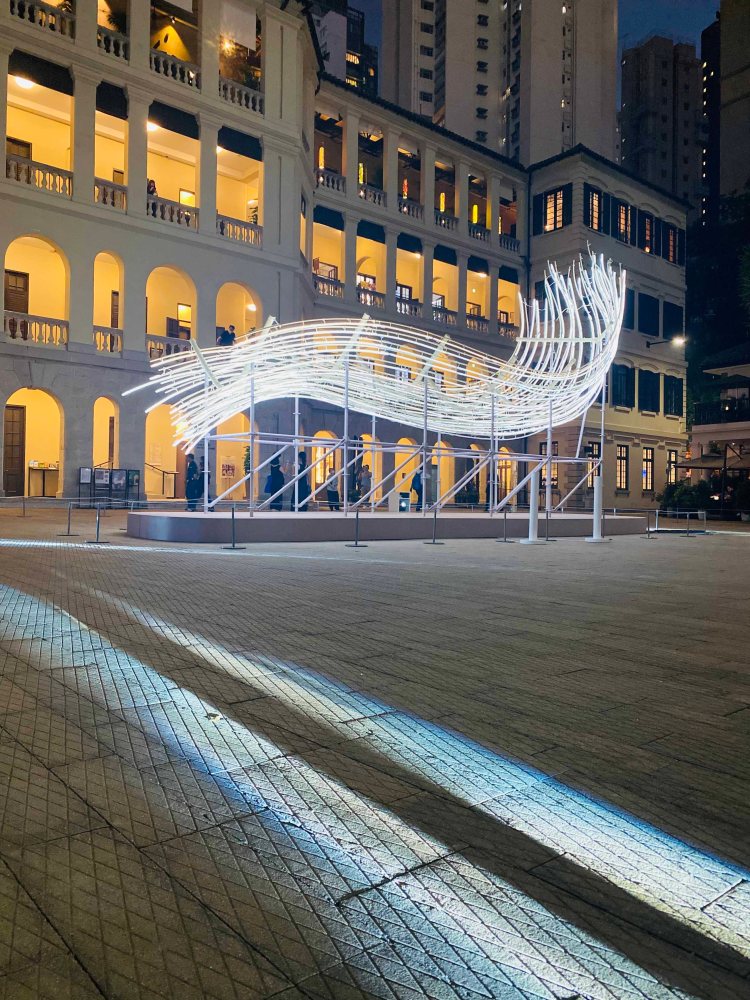
Examples:
– In “Courants“, a suspended installation with die-cut acrylic frame was used to optimise the visual effect and weight.
– In “Light as Air“, a ground-supported structures with minimal visible hardware.
10/ Refining structure for visual clarity
Custom systems are refined to reduce visual noise.
The structure should support the work, not compete with it.
11/ Packing strategy and arrangement
Finally, I plan how each element will be packed, calculating box sizes and quantities to ensure safe transport and efficient on-site handling.
Get new neon tricks, stories, and rare gas secrets by joining my newsletter below! 💙✨
